Fringes
Fringes can track the value of benefits or fees that are required above and beyond the raw cost of labor or materials. Fringe benefits could include employment taxes, fees for pension & welfare programs, or daily charges for a given resource. They might also include allowances for holiday or sick leave funds.
Fringes can also be used to track things like sales tax on materials.
Many employment benefits have a limit or cap for how much total compensation an employee can make before the Fringe benefit is cut off in a given project.
Add a new Fringe
- Open a budget and click the
Fr (fringes)Setup button- You can also press
CTRL + 3on a PC orCMD + 3on a Mac
- You can also press
- Select a Category (or leave
Uncategorizedselected) - Click to
+ ADD FRINGE- You can also select a row in the table and press
CTRL + ion a PC orCMD + ion a Mac
- You can also select a row in the table and press
- Click to select the
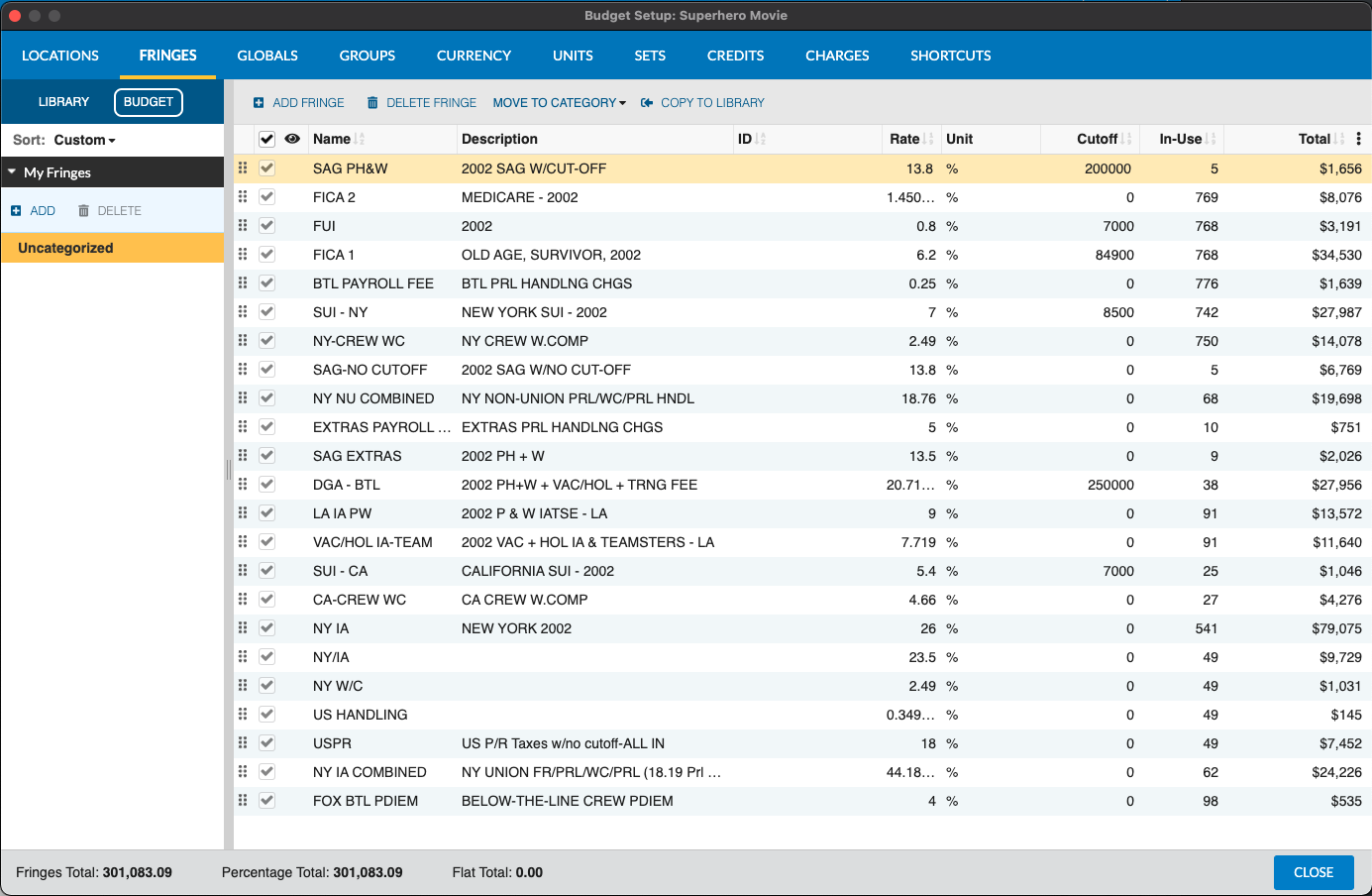
NAMEcolumn and add a unique name for the Fringe - (Optional) Add a DESCRIPTION for your Fringe
- (Optional) Add an ID for your Fringe
- Define the Rate
- This may be a raw value or a calculation (including Globals)
- The rate is assumed to be in the Base Currency for the budget unless the
Unitis%.
- Define the
Unit- Use
%if it is a percent-based Fringe
- Use
- Enter a value for the
Cutoff- Cutoff is only applicable for
%based Fringes - This determines when to stop calculating this Fringe based on the total for that row or Fringe Range.
- Cutoff is only applicable for
Duplicate a Fringe
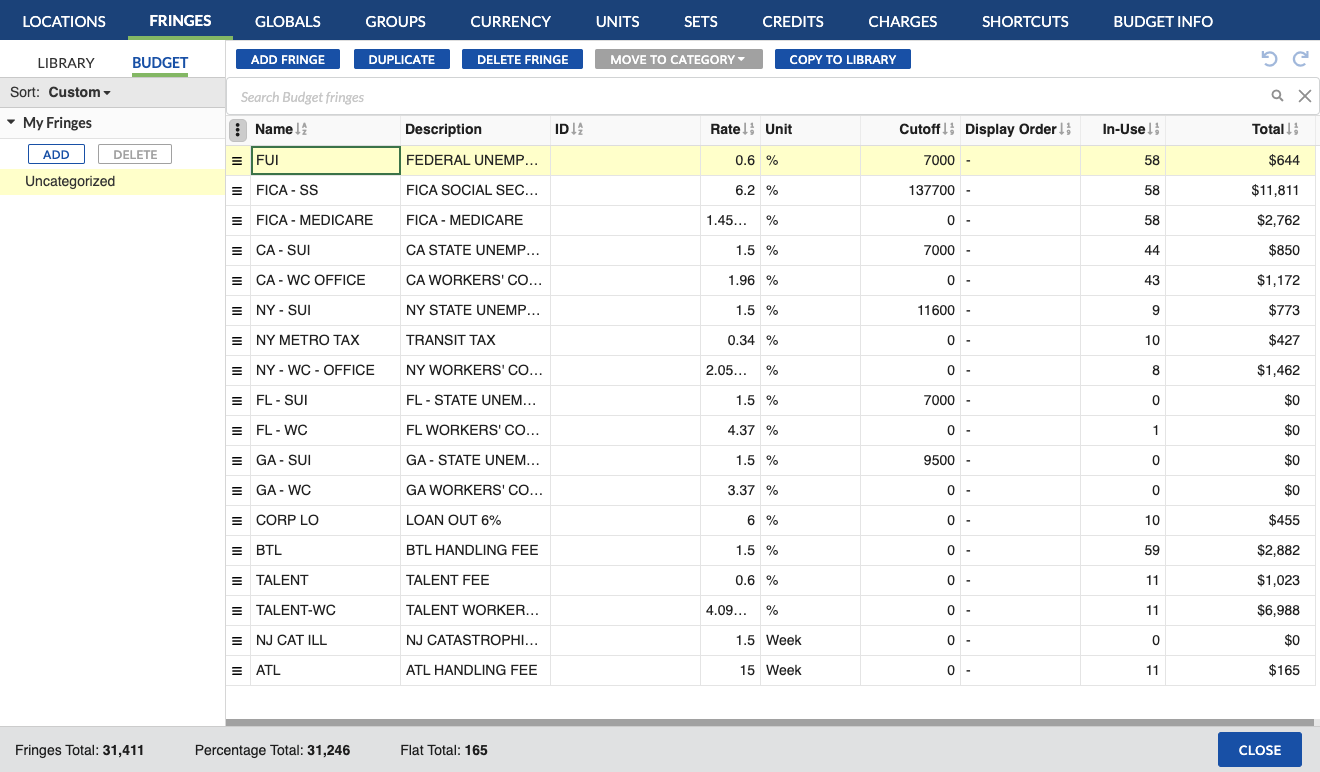
- Select the row of the Fringe you want to duplicate in Setup
- Click the
DUPLICATEbutton in the toolbar
A copy of the selected Fringe is added to the same Category with (Copy) appended to the name. Edit the name, rate, unit, or cutoff as needed before applying.
The keyboard shortcut for duplicating a row is listed in Help > Shortcut Help.
Delete a Fringe
- Select the row of the Fringe to be deleted.
- Click on the
DELETE FRINGEbutton- You can also press
CTRL + Don a PC orCMD + Don a Mac
- You can also press
If the selected Fringe is in-use somewhere in your budget, you will be warned that this may cause errors in your budget. If you are sure, select Delete Fringe to confirm.
The selected Fringe will be deleted from your budget and your totals recalculated based on this change.
Display Order
The Display Order column (1–20) in Fringes Setup controls which Fringe name appears first (leftmost) when more than one Fringe is shown in a budget column or report. Lower numbers display first.
Display Order is independent from color priority. The same Display Order column appears in Groups Setup.
Agg Sum Column at the Detail Level
Agg Sum is a read-only Detail-level column showing the sum of assigned fringe percentages as defined in Fringe Setup, before cutoffs apply. This is different from the Agg column, which shows the post-cutoff aggregate.
To show or hide Agg Sum in your budget:
- Click the
menubutton (three vertical dots) in the Detail column headers - Toggle
Agg Sum
Agg Sum is also available as a selectable column in Account Details reports. See Included Sections.
Sub-Budgets and Fringe Locking
When creating a Sub-Budget, the Include Fringes & Notes step exposes a Lock Aggregate Fringe Percentage checkbox. With it enabled, parent fringe amounts and aggregate percentages are preserved in the sub-budget even when filtered lines would otherwise recalculate them.
Editing a value in the sub-budget that triggers fringe recalculation prompts a confirmation before removing the lock. Lock removal can be reverted with CTRL + Z (PC) or CMD + Z (Mac), or by reverting through budget History.
Using Fringes
Fringes can be applied to any line or collection of lines at the Detail level of your Budget. See: Applying Fringes
Organize Fringes
See Setup Tables for more information on how to organize your Fringes and other tools.
Print Fringes
See the printing reports section to find out how to print a report of the Fringes in your budget.